



Every year, thousands of Nepali speakers in Australia take the NAATI CCL test. Most of them share a common thought: “Nepali is my native language. I speak English every day. I will easily score those 5 PR points.”
Then the results arrive. Many smart, fluent speakers fail. It feels shocking. How can someone who speaks fluent Nepali every day fail a Nepali language test?
The answer is simple. NAATI CCL is not a language fluency test. It is a consecutive interpreting exam.
Speaking fluent Nepali helps you in daily life. But interpreting under exam conditions requires a completely different set of skills to pass NAATI CCL. In this guide, we break down why fluent Nepali alone is not enough to pass NAATI CCL.
You will learn the exact skills, strategies, and vocabulary you need to clear the exam on your first attempt, or you can explore dedicated Nepali NAATI CCL preparation resources to fast-track your study and Pass NAATI CCL
Key Highlights
- Fluent Nepali Isn’t Enough: Learn why the NAATI CCL is a consecutive interpreting exam, not a language fluency test, and why many native Nepali speakers fail despite speaking the language every day.
- Discover the 7 Most Common Mistakes: Understand the biggest reasons candidates lose marks, including code-switching, missing key details, weak note-taking, summarizing instead of interpreting, and poor delivery.
- Master the Skills to Pass on Your First Attempt: Follow a practical study plan with note-taking techniques, bilingual vocabulary, memory training, and exam strategies designed to help you confidently pass the NAATI CCL exam.
What the NAATI CCL Exam Actually Tests
Many candidates think the NAATI CCL exam works like IELTS or PTE. It does not.
Tests like IELTS measure how well you read, write, speak, and listen in one language. NAATI
The test simulates real-world Australian community conversations. You listen to recordings of two people having a conversation. One person speaks English. The other person speaks Nepali.
Your job is to act as the interpreter. You must listen to each segment, process the meaning, and speak the message clearly in the other language to pass NAATI CCL.
Exam Structure at a Glance
| Feature | Details |
| Total Dialogues | 2 dialogues |
| Segments per Dialogue | 10 to 14 segments |
| Word Count per Segment | Up to 35 words |
| Total Marks | 90 marks (45 marks per dialogue) |
| Passing Score | At least 29/45 in each dialogue AND 63/90 overall |
| Domains Covered | Health, Law, Housing, Education, Immigration, Financial, Social Services |
Examiners do not judge you on how fancy your words sound. They judge you on:
- Accuracy: Did you convey the exact message without changing anything?
- Completeness: Did you leave out any facts, dates, or numbers?
- Terminology: Did you use correct English and Nepali community words?
- Delivery: Did you speak smoothly without long pauses or self-corrections?
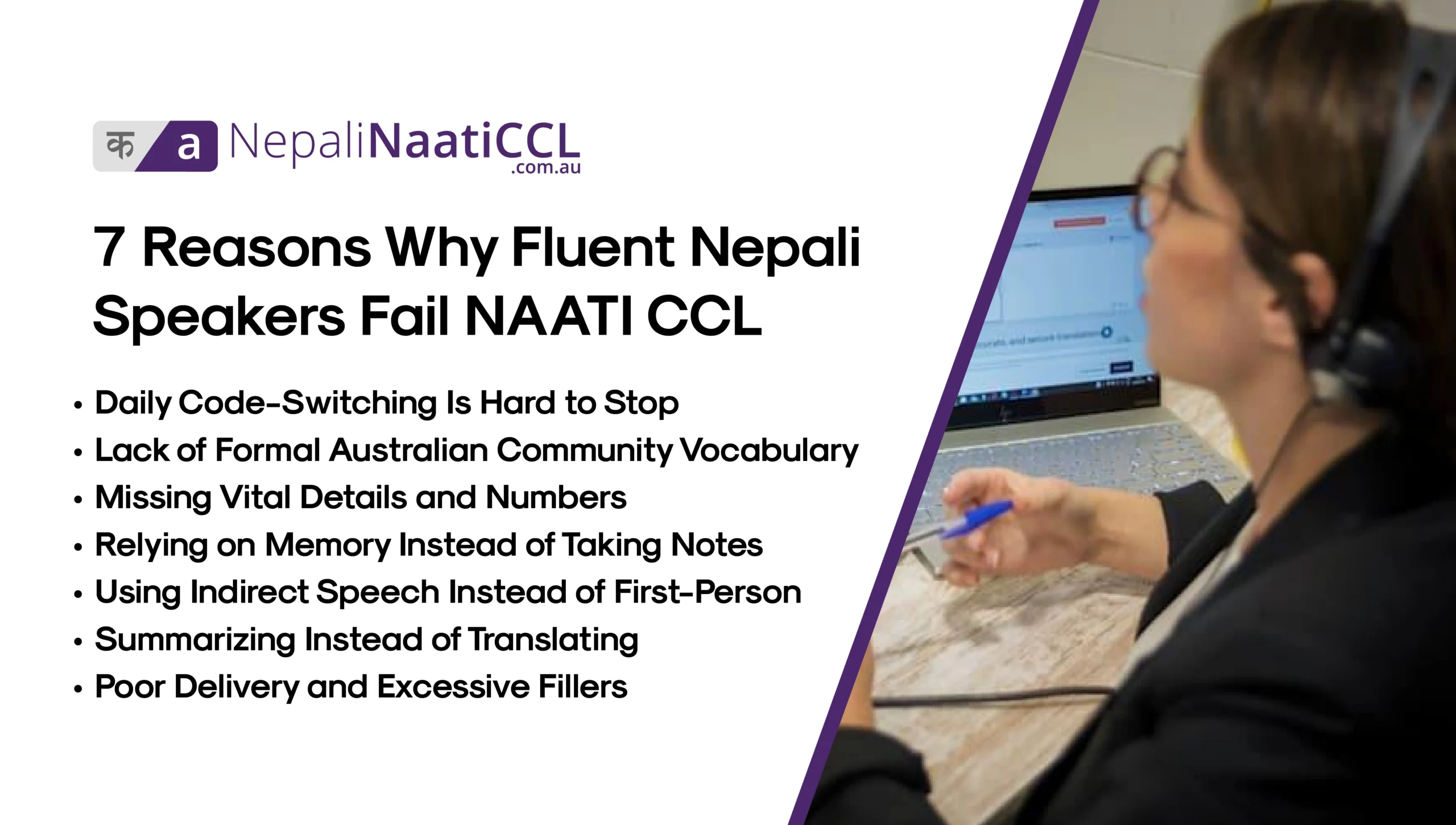
7 Reasons Why Fluent Nepali Speakers Fail NAATI CCL
Understanding why fluent native speakers fail is the first step toward learning how to pass NAATI CCL. Here are the seven biggest reasons.
1. Daily Code-Switching Is Hard to Stop
In daily life, Nepali speakers in Australia mix English and Nepali constantly. You might say:
“Aaja mero appointment chha, so maile leave linu parchha.”
In casual talks, this mixed language works fine. But if you want to pass NAATI CCL, unjustified code-switching loses marks.
If the speaker says “appointment” in English, you must translate it accurately into Nepali (अपॉइन्टमेन्ट or भेट्ने समय) when interpreting to Nepali. If you drop English words into your Nepali output without cause, examiners deduct points for poor language control.
2. Lack of Formal Australian Community Vocabulary
You might speak great conversational Nepali at home. But do you know the formal Nepali terms for Australian government and health services to pass NAATI CCL?
Consider these common terms:
- Tenancy agreement
- Physiotherapist
- Restraining order
- Interim visa
- Superannuation
- Bulk billing
If you struggle to find the exact Nepali term within 3 seconds, you will freeze. Freezing leads to hesitation, self-correction, or flat-out guessing.
3. Missing Vital Details and Numbers
When we listen to normal talk, our brains naturally summarize. We keep the main idea and discard the small details.
NAATI CCL penalizes this habit heavily. Examiners track every single piece of information.
If a speaker says:
“Take two tablets every six hours after meals for five days.”
And you interpret:
“खाना खाएपछि दिनको दुई पटक औषधि खानुहोस्।” (Take medicine twice a day after meals.)
You just lost major points. You changed “every six hours” to “twice a day.” You omitted “five days.” You changed “two tablets” to general medicine. Even though your Nepali sounded natural, the interpretation was inaccurate and won’t help you pass NAATI CCL.
4. Relying on Memory Instead of Taking Notes
A single exam segment can be up to 35 words long. It often contains complex data like street names, phone numbers, dates, and medical symptoms.
Fluent speakers often trust their memory. They listen without writing anything down. But by word 25, short-term memory gets overloaded.
When you start speaking, you suddenly forget the date or the exact name of the department. You stutter, pause, or skip the fact entirely.
5. Using Indirect Speech Instead of First-Person
Inexperienced test takers fall into the trap of indirect speech. They act like a storyteller instead of an interpreter.
- ❌ Incorrect (Indirect): “डाक्टरले भन्दै हुनुहुन्छ कि उहाँलाई टाउको दुखेको छ।” (The doctor says that he has a headache.)
- ✅ Correct (First Person): “मेरो टाउको दुखेको छ।” (I have a headache.)
In NAATI CCL, you must always interpret in the first person. You are the voice of the speaker. Slipping into “he said” or “she told me” results in repeated scoring deductions.
6. Summarizing Instead of Translating
Native speakers often listen to a long segment and rephrase it in their own words. They capture the general idea but rewrite the sentence structure.
NAATI penalizes summarizing. You must render every adjective, condition, and emphasis. If the speaker says “severely painful,” translating it simply as “painful” (दुख्छ) loses precision marks.
7. Poor Delivery and Excessive Fillers
In casual Nepali conversation, we frequently use filler words:
- “अँ…” (Umm…)
- “चाहिँ…” (Chahi…)
- “अनि…” (Ani…)
- “मतलब…” (Matlab…)
In the exam, using excessive filler words damages your fluency score. Long pauses over 3 seconds, false starts, and repeated self-corrections tell the examiner that you lack interpreting fluency.
Real Example Breakdown: Where Points Are Lost
Let’s look at how a native Nepali speaker can lose 8 out of 10 marks on a simple segment.
Original English Segment:
“Good morning, Mrs. Sharma. I have reviewed your blood test results from last Tuesday, and your iron levels are still quite low.”
Candidate’s Response:
“नमस्ते शर्मा जी। मैले तपाइँको गत हप्ताको रगत जाँच हेरेँ, अनि तपाइँको आइरन अलि कम छ।”
What Went Wrong Here?
| EXAMINER DEDUCTION SHEET | |
| Mistake | Analysis & Penalty |
| “Good morning” | Translated as “नमस्ते” (Missed time context) |
| “last Tuesday” | Changed to “गत हप्ता” (Lost specific day) |
| “quite low” | Translated as “अलि कम” (Distorted severity) |
| Delivery | Hesitated twice with “अनि… अ…” |
The Correct Interpretation:
“शुभ प्रभात, श्रीमती शर्मा। मैले गएको मंगलबारको तपाईँको रगत परीक्षणको नतिजा हेरेको छु, र तपाईँको आइरनको मात्रा अझै पनि निकै कम छ।”
Notice how the correct version keeps every single detail intact:
- “Good morning” → शुभ प्रभात
- “Mrs. Sharma” → श्रीमती शर्मा
- “Reviewed” → हेरेको छु
- “Last Tuesday” → गएको मंगलबार
- “Blood test results” → रगत परीक्षणको नतिजा
- “Quite low” → निकै कम
6 Core Skills You Need to Master
To pass NAATI CCL, you must train like an interpreter. You need to build six core skills.
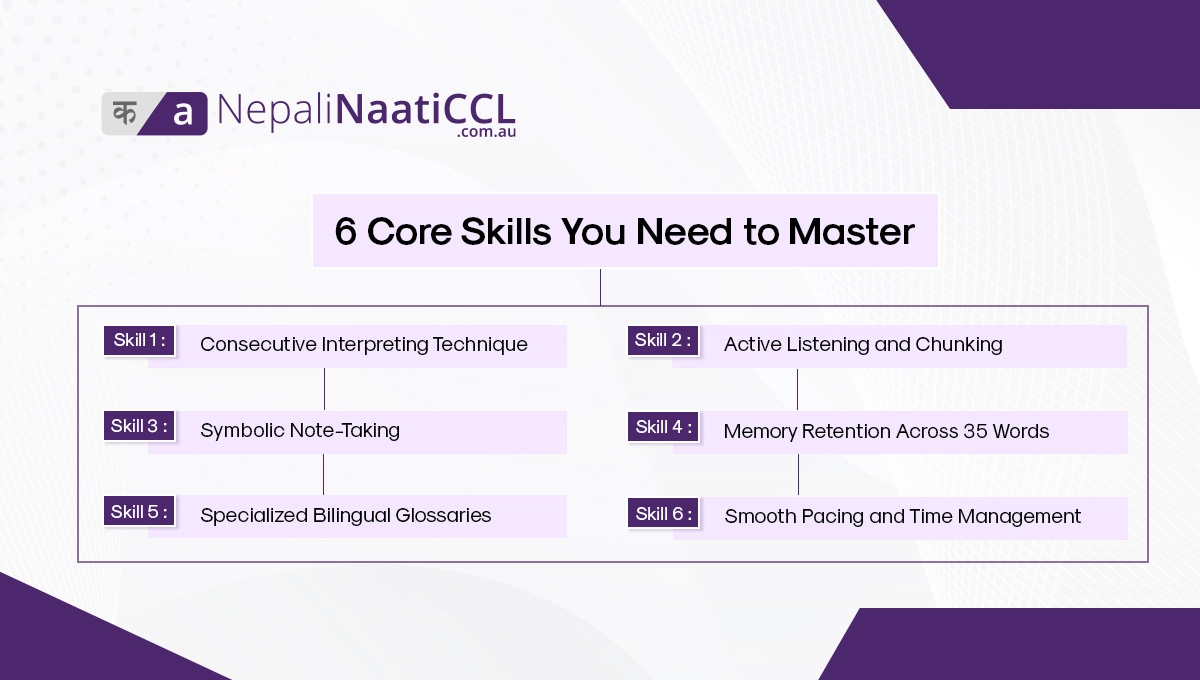
Skill 1: Consecutive Interpreting Technique
You must learn to wait for the segment to finish, take a breath, and deliver the interpretation smoothly within 3 to 5 seconds. Do not start speaking while the audio is playing. Do not wait longer than 5 seconds after the audio stops.
Skill 2: Active Listening and Chunking
Train your brain to listen for meaning chunks rather than individual words. Group ideas together:
- Chunk 1: Who is speaking? (Doctor)
- Chunk 2: What happened? (Reviewed blood test)
- Chunk 3: When? (Last Tuesday)
- Chunk 4: What is the result? (Iron levels quite low)
Skill 3: Symbolic Note-Taking
You need a clear shorthand system. Never try to write down full sentences in Nepali or English during the exam. You will fall behind.
Use symbols, arrows, and abbreviations:
- Pt = Patient
- Hosp = Hospital
- ↑ = Increased / High
- ↓ = Decreased / Low / Drop
- Tue = Tuesday
- Rx = Treatment / Medicine
- $ = Money / Fee / Cost
Skill 4: Memory Retention Across 35 Words
Practice expanding your mental holding capacity. Listen to 30-word sentences without taking notes at first, then repeat them back in the same language. Once your retention improves, practice switching languages.
Skill 5: Specialized Bilingual Glossaries
You must build and memorize bilingual glossaries for all major Australian public domains. Knowing these terms removes hesitation during the exam.
If you want structured guidance, practice materials, and mock tests designed specifically for Nepali test takers to help you pass NAATI CCL, check out dedicated Nepali NAATI CCL preparation resources to speed up your learning curve.
Skill 6: Smooth Pacing and Time Management
Keep your voice calm, steady, and clear. Maintain a consistent volume. If you make a mistake, correct it immediately and move on smoothly. Do not dwell on missed words.
Essential Australian Community Domains (Nepali & English)
Here is a quick reference table of essential vocabulary terms across key exam domains:
| Domain | English Term | Accurate Nepali Equivalent |
| Healthcare | Side effects | असरहरू / पार्श्व प्रभाव |
| Healthcare | Blood pressure | रक्तचाप |
| Housing | Lease agreement | भाडा सम्झौता |
| Housing | Bond refund | धरौटी रकम फिर्ता |
| Legal | Court summons | अदालतको पुर्जी |
| Legal | Restraining order | निषेधाज्ञा / प्रतिबन्ध आदेश |
| Immigration | Permanent residency | स्थायी आवास (PR) |
| Immigration | Visa conditions | भिसाका सर्तहरू |
| Social Services | Family allowance | पारिवारिक भत्ता |
| Education | Parent-teacher interview | अभिभावक-शिक्षक भेटघाट |
| Finance | Interest rate | ब्याजदर |
| Employment | Workers’ compensation | कामदार क्षतिपूर्ति |
Common Exam Pitfalls and How to Fix Them
| COMMON EXAM PITFALLS & SOLUTIONS | ||
| Pitfall | Why Candidates Do It | How to Fix It |
| Freezing on a word | Lack of domain vocab | Use a simple synonym or explain the term |
| Dropping numbers | Poor note-taking | Write down ALL numbers immediately |
| Over-using fillers | Nervousness, thinking while speaking | Take a 2-second silent pause before speaking |
| Using indirect speech | Habit from normal conversation | Train in 1st person exclusively |
What to Do When You Hit an Unknown Word
Even well-prepared candidates encounter unfamiliar words during the exam. What should you do?
- Do not panic or freeze. A 10-second silence causes severe fluency deductions.
- Use context clues. What makes sense in this scenario?
- Paraphrase the concept. If you forget the exact term for “Physiotherapist,” explain it accurately: “मांसपेशी र हाडजोर्नीको व्यायाम गराउने विशेषज्ञ”.
- Request a repeat if needed. You get one free repeat per dialogue without penalty. Use it strategically on complex segments!
Step-by-Step Study Plan to Pass NAATI CCL Nepali
Week 1: Master the Exam Format & Core Vocabulary
- Study the NAATI CCL marking rubric and point deduction rules.
- Learn 50 essential terms for Healthcare, Housing, and Legal domains.
- Practice converting English terms directly into accurate Nepali equivalents without code-switching.
Week 2: Build Note-Taking and Short-Term Memory
- Create your personal shorthand note-taking symbol chart.
- Practice listening to 25–35 word segments.
- Focus on capturing every number, date, address, and proper noun on paper.
Week 3: Record and Audit Full Dialogues
- Practice 2 to 3 full dialogues every day.
- Record your output on your phone or computer.
- Play back your recordings against the script to spot omissions, additions, and hesitations.
Week 4: Take Timed Mock Tests Under Exam Conditions
- Complete full mock exams without pausing or rewinding tracks.
- Limit yourself to one repeat request per dialogue.
- Eliminate filler words (अँ, चाहिँ, अनि) from your delivery.
Working with realistic practice sets and getting expert feedback makes a huge difference. Using structured resources from specialized sites like Nepali NAATI CCL ensures you prepare with exam-accurate materials that reflect current test trends.
Final Thoughts
Being fluent in Nepali is a great advantage, but it is only half the battle. Passing NAATI CCL requires specific interpreting skills that you must build through focused practice.
To secure your 5 PR points, shift your mindset today. Stop practicing as a language speaker and start practicing as a professional interpreter. Focus on note-taking, memorize key Australian domain vocabulary, record your practice sessions, and deliver every segment with confidence using proven Nepali NAATI CCL strategies to pass NAATI CCL!
Frequently Asked Questions (FAQ)
Is native Nepali fluency enough to pass the NAATI CCL exam?
No. Native fluency is a great starting point, but NAATI CCL tests consecutive interpreting skills. You must demonstrate message accuracy, note-taking ability, domain-specific terminology, and smooth delivery under time pressure to pass NAATI CCL.
What is the minimum score required to pass the NAATI CCL?
You need an overall score of at least 63 out of 90 marks. Additionally, you must score at least 29 out of 45 marks in each of the two individual dialogues.
Can I ask for a repeat during the exam?
Yes. You can request one free repeat per dialogue without any mark deduction. Additional repeats in the same dialogue will result in a small penalty.
What if I make a mistake while interpreting?
If you realize you made a mistake, correct yourself immediately. Say “सच्याउनुहोस्” or “Correction,” and state the correct translation. If done promptly, examiners will mark your corrected response.
How long should I prepare for the NAATI CCL Nepali exam?
Most candidates need 3 to 6 weeks of dedicated, daily practice. Focusing on note-taking, domain vocabulary, and timed mock tests yields the best results to pass the NAATI CCL.
Do I lose points if I use English words in my Nepali response?
Yes, if there is a proper Nepali equivalent for the word. Unnecessary code-switching signals poor vocabulary control and leads to score deductions.